
Why relying on one forensic suite creates systemic investigative risk
Contributed by Kris Carlson, COO, Former ICAC Commander, Digital Forensics Investigator, and Testifying Expert
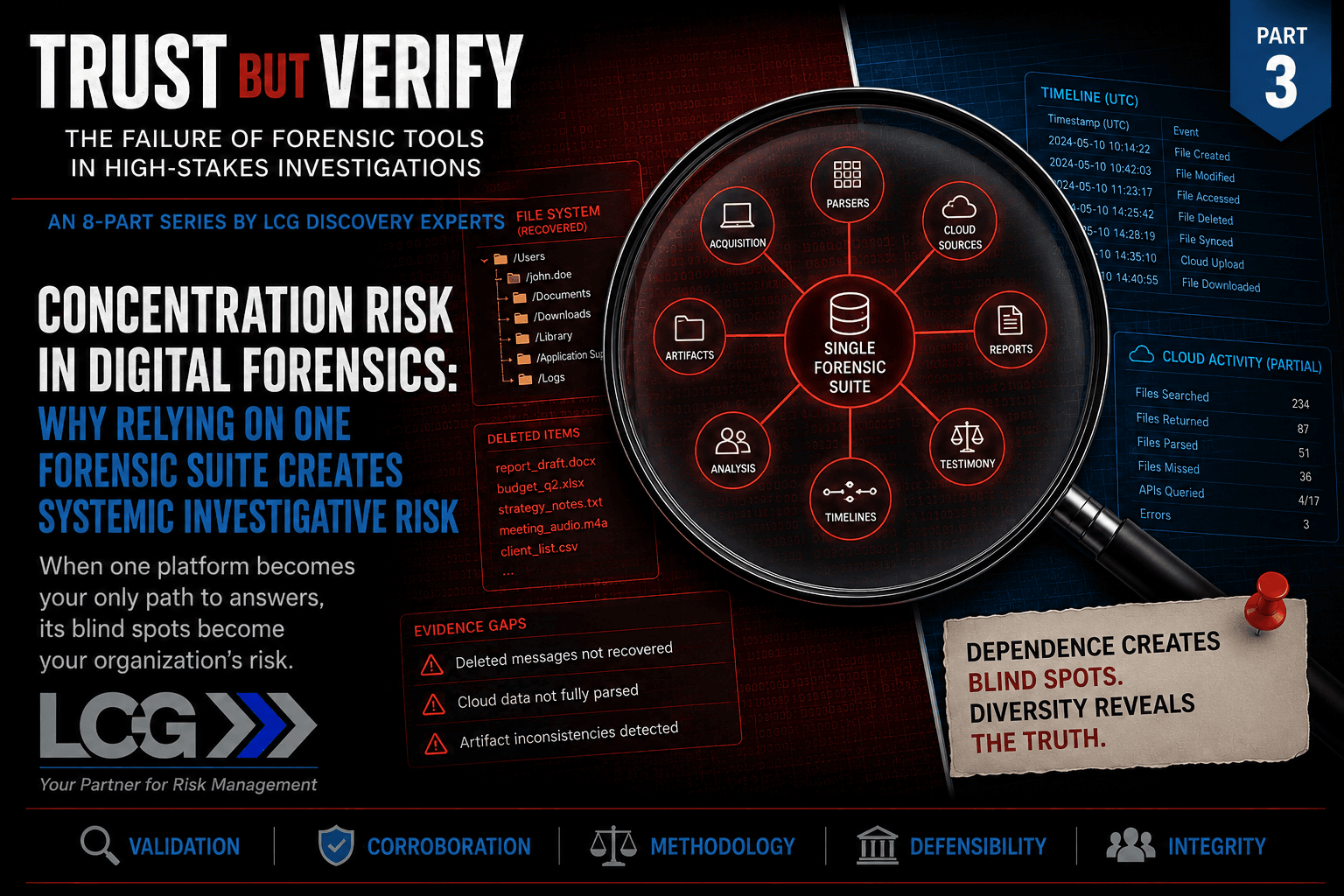
Series Context. In Part 1, we examined why no forensic tool should ever be treated as a single source of truth. In Part 2, we explored silent failures and the dangers of omission errors that may go undetected for months or years. Those discussions naturally lead to a broader question: What happens when an entire organization relies on the same forensic platform, parsers, and assumptions for every investigation it conducts? The answer is a form of investigative concentration risk that can transform isolated software limitations into systemic organizational risk.
When Efficiency Becomes Vulnerability
Discussions about forensic reliability focus on whether a particular tool worked correctly in a particular case. That question matters, but it is not the only question.
A broader and often more important question is what happens when an entire forensic program becomes dependent on the same software platform, acquisition methods, parsers, reporting structure, and interpretive framework across nearly every investigation.
At that point, the risk is no longer limited to whether a single tool fails in a single case. The risk becomes systemic.
The concern is not unique to digital forensics. Risk managers see the same issue in other industries. Cybersecurity professionals recognize the danger of excessive dependence on a single technology stack. Financial institutions treat overconcentration as an operational risk. Supply chain managers understand the consequences of relying too heavily on one critical vendor.
The principle is straightforward: when a single dependency becomes deeply embedded in an operational process, any weakness in that dependency can affect the entire system.
Digital forensics is increasingly vulnerable to this same problem.
Modern forensic platforms are extraordinarily capable. Many organizations now rely on a single suite to acquire evidence, parse artifacts, collect cloud data, generate timelines, produce reports, and support expert testimony. The efficiencies are real. Training becomes easier. Workflows become more consistent. Quality assurance becomes more manageable. Reports become more uniform.
Those are legitimate benefits.
The danger begins when standardization turns into dependence. A tool that was adopted to improve efficiency can gradually become the default answer to every forensic question. Over time, the organization may stop asking whether the platform is the right tool for a particular evidence source, artifact type, operating system, application version, or investigative issue.
LCG Perspective. Standardization creates efficiency. Dependency creates vulnerability. The challenge for mature forensic programs is recognizing when one has become the other.
Repetition Does Not Equal Validation
One of the most overlooked risks in digital forensics is confusing consistency with validation.
Consider a mobile device reviewed independently by three experienced examiners. Each examiner uses the same forensic platform, follows established procedures, and reaches the same conclusion. At first glance, the result appears reassuring. Three separate reviews produced the same finding.
But the reviews may not be truly independent.
If each examiner relied on the same acquisition engine, artifact parser, timestamp normalization logic, and reporting framework, they were effectively evaluating the evidence through the same technical process. Their conclusions may be correct, but they may also reflect the same assumptions, limitations, or parsing errors.
That distinction matters. Reaching the same result by the same method is not the same as validating it through independent means.
The forensic community often discusses validation in terms of repeatability and reproducibility. Those concepts are important, but they can be misunderstood. Repeating the same process multiple times may show that the process produces consistent results. It does not necessarily show that the results are complete or accurate. A flawed process can be repeated perfectly and remain flawed.
True validation often requires methodological diversity. That may include using a second forensic tool, reviewing source databases or logs, comparing results against known test data, examining the native application where appropriate, or validating key artifacts through manual analysis.
Without that diversity, organizations may develop confidence in findings that have never been meaningfully challenged. The result is not independent confirmation. It is a repeated reliance on the same system.
Same Evidence, Different Interpretations
A common misconception in digital forensics is that major forensic platforms interpret evidence in essentially the same way. They do not.
Every forensic vendor makes technical and design decisions about how evidence is acquired, parsed, normalized, categorized, searched, and presented to the examiner. Engineering priorities, development resources, artifact support strategies, testing processes, and implementation choices influence those decisions.
They are also influenced by timing. Applications, operating systems, hardware, cloud services, and encryption models change constantly. Vendors must update their tools to account for those changes, but they do not all do so at the same pace. One platform may quickly support a new operating system version, database structure, or cloud API change, while another may lag or support it only partially.
As a result, different tools can produce different results from the same evidence source.
One platform may recover deleted records that another does not identify. One parser may correctly interpret a recently modified application database while another fails to recognize the same artifacts. One timeline engine may normalize timestamps differently. One cloud acquisition method may collect data categories that another cannot access. One report may surface artifacts that another tool stores in a different category or does not present at all.
These differences do not automatically mean that one tool is defective. They reflect the reality that digital forensic interpretation is not a universally standardized process. Tool output is shaped by the method used to collect the data, the logic used to parse it, and the assumptions built into the platform.
This reality is becoming more important as applications evolve faster than forensic tools can keep pace. Messaging platforms change database structures. Cloud providers modify APIs. Operating systems introduce new security controls. Encryption models continue to advance. Each change creates another opportunity for tools to diverge in what they acquire, recognize, interpret, or report.
That divergence should not be viewed only as a problem. It should also be viewed as an opportunity for validation.
When different tools or methods independently support the same conclusion, confidence in the finding increases. When they produce different results, the discrepancy can help identify limitations, unsupported artifacts, parsing issues, or areas requiring deeper examination.
The Risk of Tool-Driven Categorization
Modern forensic tools are no longer limited to extracting files and displaying raw artifacts. Increasingly, they are designed to interpret, organize, and present evidence through polished graphical interfaces. These interfaces can group artifacts into familiar categories, label activity types, populate timelines, identify relationships, and present the examiner with a seemingly organized view of the evidence.
This can be extremely useful. Clear categorization allows examiners to move through large data sets more efficiently, identify relevant evidence faster, and explain findings in a more accessible way to investigators, attorneys, regulators, and courts.
But the same feature also creates risk.
When a tool labels data as “cloud storage,” “messages,” “downloads,” “user activity,” or “application artifacts,” it is not merely displaying evidence. It is applying an interpretive framework to the underlying data. Different tools may apply that framework in different ways.
For example, one tool may identify files from a cloud-synced folder and categorize them as “cloud storage data.” Another tool may simply display the same files as data located in a particular file path, such as a OneDrive, Dropbox, Google Drive, or iCloud sync directory. A third tool may separate the local file, along with sync metadata, account information, and related timestamps, into different artifact categories.
The underlying evidence may be the same, but the presentation can lead the examiner to understand it differently.
That distinction matters. A category label can influence how evidence is searched, filtered, reviewed, reported, and explained. If the examiner accepts the tool’s categorization without understanding the underlying data source, important context may be missed. A file shown as local data may actually reflect cloud synchronization activity. A file shown as cloud-related may still require analysis to determine whether it was opened, downloaded, cached, synced, or merely referenced by the local system.
Graphical interfaces are valuable, but they should not become a substitute for forensic understanding. Examiners must be able to look beyond the category assigned by the tool and ask what the data actually represents, where it came from, how it was created, and what limitations may exist in the way it was parsed or presented.
LCG Perspective. A tool category is not a forensic conclusion. It is a presentation choice. The examiner’s responsibility is to understand the underlying evidence well enough to explain what the artifact actually means, not merely where the software placed it.
Case Vignette: The Conversation Nobody Saw
Consider a corporate investigation involving allegations of improper coordination among several employees. The employees’ mobile devices are acquired and processed using a well-established forensic platform. Investigators identify relevant communications, generate reports, and rely on those reports to support their findings. The evidence appears complete, and the conclusions appear well supported.
Months later, during litigation, an opposing expert conducts an independent review. The expert processes the same evidence with a different forensic platform and supplements the review with direct SQLite examination.
The messages identified in the original investigation are still present. But additional communications have also been identified.
A recent application update had altered portions of the underlying database structure. The original parser recovered many of the messages but failed to associate several conversation records with the correct participants. The data was present, the acquisition had succeeded, no error message appeared, no warnings were generated, and the report looked complete.
The omitted communications became visible only because a different methodology was applied.
The issue was not necessarily examiner incompetence. The issue was reliance on a single interpretive framework. Once the evidence entered litigation, however, the consequences were not measured by intent; they were measured by what was missed, whether the methodology was defensible, and how the omission affected the conclusions that had already been reported.
Open Source and Commercial Tools Are Not Competitors
Discussions about forensic validation are sometimes framed as a choice between commercial tools and open-source tools. That framing misses the point.
The objective is not to prove that one category of tool is superior to another. The objective is to increase confidence in the investigative conclusion.
Commercial forensic platforms provide substantial advantages. They offer scalability, technical support, workflow integration, automation, reporting capabilities, and broad artifact coverage. For many organizations, those capabilities are essential to managing modern forensic work at scale.
Open-source tools provide different advantages. They can offer transparency, community review, direct access to artifacts, flexibility, and the ability to test specific findings outside the interpretive framework of a commercial platform. Tools such as Autopsy, ALEAPP, iLEAPP, DB Browser for SQLite, and direct filesystem or database examination can serve as valuable validation resources and another tool in the toolbox for analysts.
Their value is not that they replace commercial platforms, rather they provide an independent perspective.
A mature forensic program does not treat validation as loyalty to a particular tool category. It treats validation as a methodological requirement. When different tools, techniques, or direct source examinations support the same conclusion, confidence increases. When they produce different results, the differences can identify limitations, unsupported artifacts, parsing issues, or areas requiring further review.
Building Resilience Through Tool Diversity
The solution to concentration risk is neither to acquire every forensic tool on the market nor to abandon standardization; the objective is resilience.
Organizations should maintain their primary workflows while preserving the ability to verify critical findings independently.
That verification may include:
- Secondary forensic platforms
- Open-source validation tools
- Direct database examination
- Manual artifact review
- Known validation datasets
- Regression testing after major updates
- Peer review using alternative methodologies
Not every artifact requires multiple layers of analysis, and not every case requires exhaustive validation. The level of effort should be driven by risk. High-impact findings deserve greater scrutiny, particularly when the conclusions may carry legal, regulatory, financial, or reputational consequences. The goal is not to pursue perfection in every examination, but to apply enough independent verification to make the methodology and conclusions defensible.
Quick Checklist
- Avoid relying exclusively on a single forensic platform.
- Validate critical findings using independent methods.
- Maintain secondary validation capabilities.
- Incorporate direct artifact review when appropriate.
- Perform regression testing after major software updates.
- Document discrepancies and validation decisions.
- Treat consistency as a starting point for verification, not proof of accuracy.
Final Thought
Modern forensic software has transformed investigative capabilities. The speed, scale, and sophistication available to investigators today would have been difficult to imagine only a decade ago. Those advances deserve recognition, but they also deserve scrutiny.
The greatest threat to forensic reliability is not always a visible tool failure. It is the organizational assumption that a single forensic ecosystem can answer every investigative question without independent verification.
Concentrated environments create efficiency by simplifying complex work. They also create risk by concentrating assumptions, dependencies, and blind spots. A mature forensic program recognizes both sides of that equation. Standardization can improve consistency, but independent validation is what creates confidence when findings are challenged.
Trust and verification are not opposing concepts. They are complementary disciplines. Trust enables efficient workflows. Verification provides the confidence needed to defend those workflows.
In digital forensics, resilience does not come from having one tool that never fails. It comes from having a methodology that can identify, test, and withstand failure when it inevitably occurs.
This article is for general information and does not constitute legal advice.