

Contributed by Jim Brigham, LCG VP of Risk Management, Former Operations Chief, State of Vermont, Office of Safety and Security
Artificial intelligence will not replace experienced analysts, investigators, or threat-management professionals. Its real value is its ability to process information at a scale and speed no human team can match.
During my public-sector service, today’s AI capabilities were not readily available. Had they been, they could have significantly strengthened our ability to connect information from incident reports, open-source intelligence, law-enforcement partners, facility systems, and other authorized sources. Properly configured AI agents could continuously monitor approved sources, identify changes involving persons or situations of concern, correlate new information with existing cases, and alert analysts to developments requiring review.
Emerging technologies were already demonstrating this potential. License-plate recognition systems could be integrated with cameras and watch lists to notify authorized personnel when an identified vehicle approached a protected location. AI greatly expands that concept by detecting relationships, changes, and recurring patterns across far larger volumes of information.
The advantage is not simply faster searching. AI can help analysts identify connections that might otherwise remain hidden:
- Repeated references to the same person, vehicle, address, organization, or location.
- Changes in the frequency, tone, or specificity of concerning communications.
- Escalating grievances or behavioral indicators across multiple platforms.
- Connections among reports filed by different offices or agencies.
- New information that alters a previously completed assessment.
But AI also introduces serious risks. Data may be inaccurate, outdated, biased, misidentified, or taken out of context. A shared name, vehicle, address, or online connection does not prove threatening intent. Automated systems can generate false positives, and poorly designed tools may produce conclusions that appear authoritative without showing how they were reached.
That is why explainability and human review are essential. Analysts must be able to identify the information supporting an alert, evaluate the reliability of its sources, verify important findings, and explain how the information affects the assessment. AI-generated results should inform professional judgment, not replace it.
Organizations must also establish clear limits governing authorized sources, privacy, data retention, access, auditing, and when information may be shared or acted upon. Continuous monitoring without defined authority and oversight can quickly become indiscriminate surveillance.
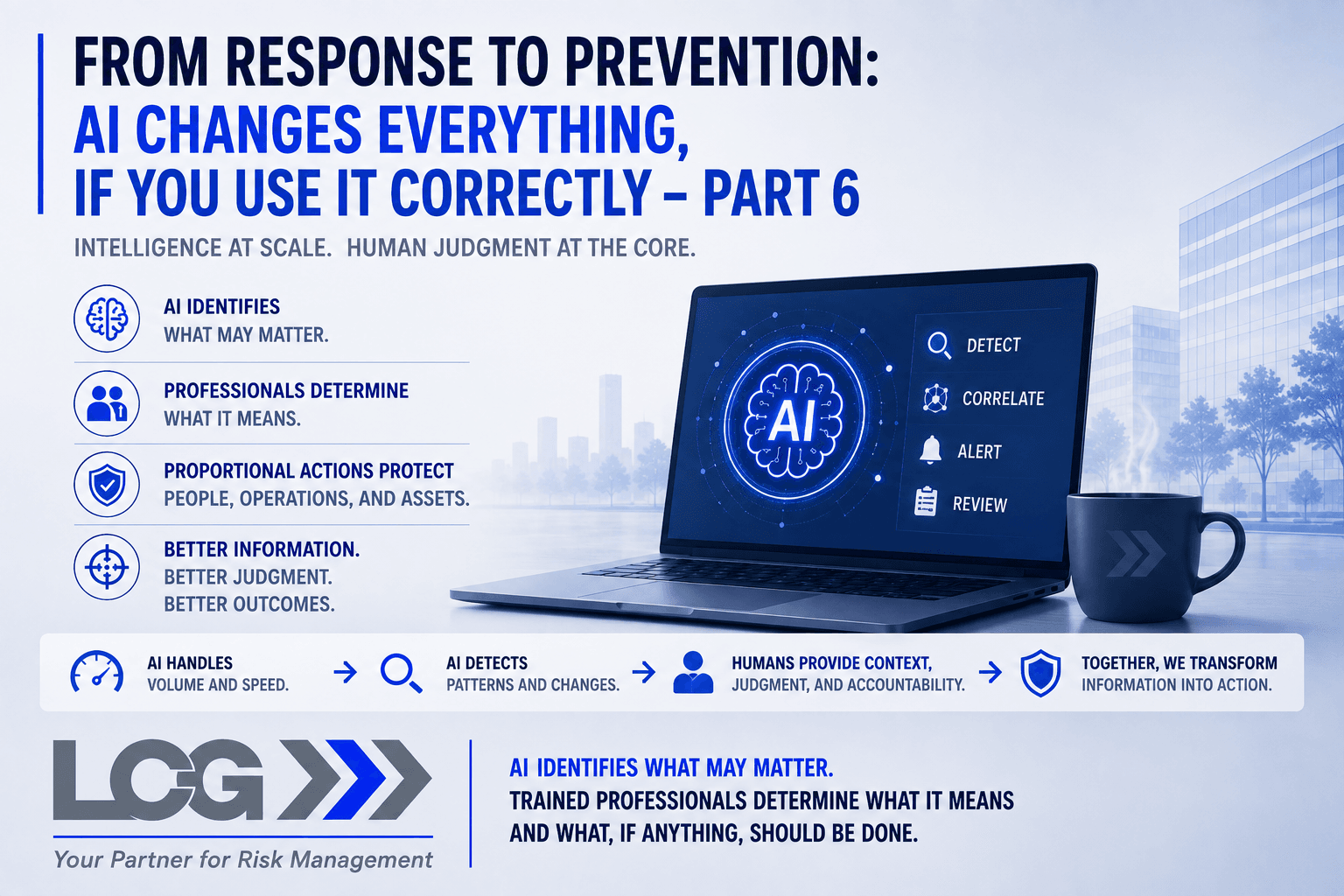
Used correctly, AI becomes a force multiplier. It handles volume, detects patterns, maintains continuous awareness, and brings potentially important changes to an analyst’s attention. Humans provide context, judgment, proportionality, accountability, and the ability to recognize when the technology is wrong.
The proper model is not AI instead of analysts. It is:
AI identifies what may matter. Trained professionals determine what it means and what, if anything, should be done.