

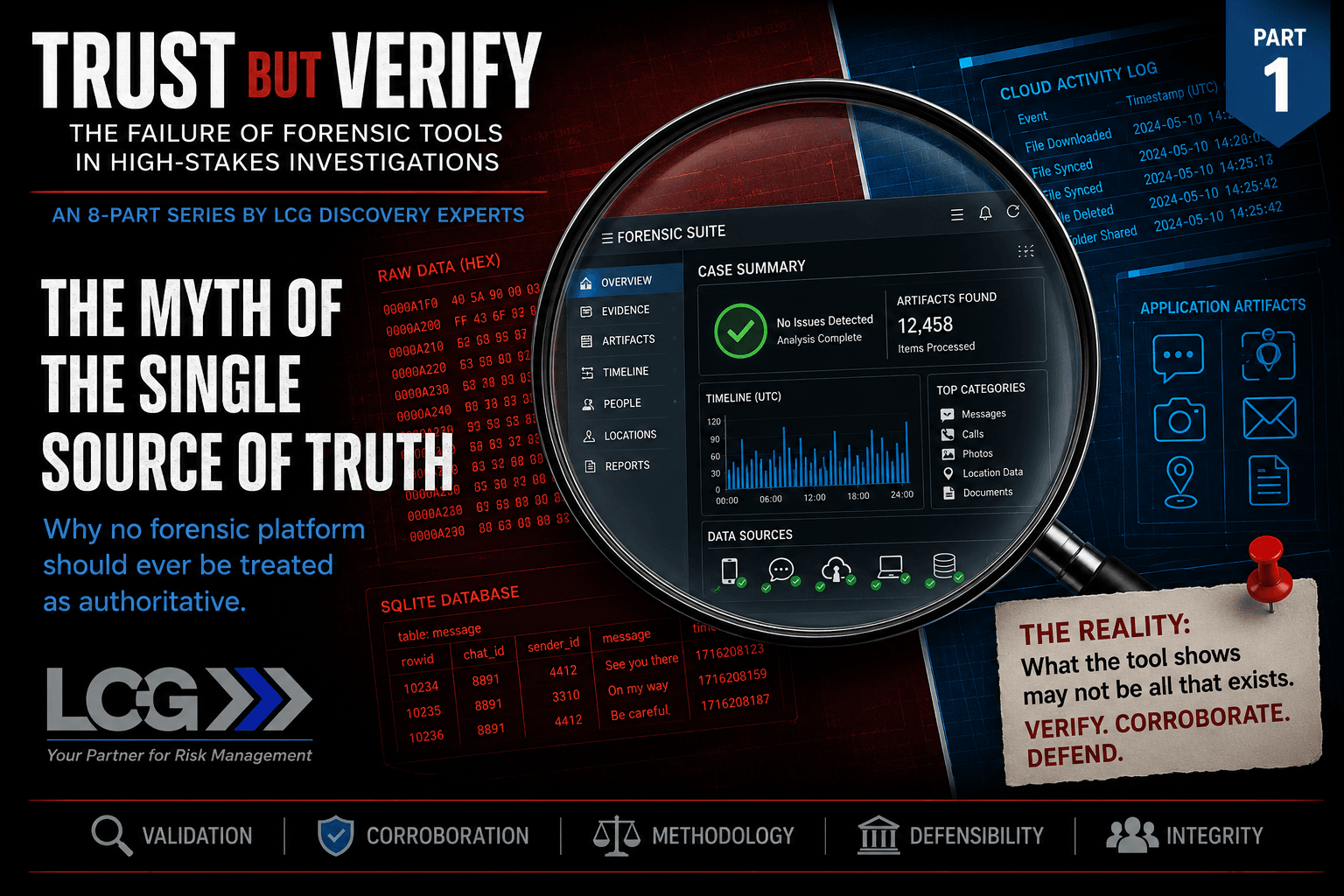
Why no forensic platform should ever be treated as authoritative
Contributed by Kris Carlson, COO, Former ICAC Commander, Digital Forensics Investigator, and Testifying Expert
Series Context. Digital forensic practitioners increasingly rely on sophisticated commercial platforms that promise speed, automation, and defensibility. While these tools have transformed investigative workflows, parsing failures, unsupported artifact issues, and silent processing errors remind us of an uncomfortable truth: no forensic tool is infallible. This series examines why validation, corroboration, and methodological discipline remain essential to investigative integrity in the age of forensic automation. [1]
The Comforting Illusion of a Single Source of Truth
Digital forensic software has become extraordinarily powerful.
Modern forensic platforms can acquire and process data from mobile devices, computers, external storage media, cloud accounts, email systems, messaging platforms, social media accounts, enterprise collaboration tools, application databases, network artifacts, and other digital evidence sources. They can parse thousands of application artifacts, reconstruct user activity timelines, identify communications and relationships, and generate polished reports for investigative, regulatory, and legal audiences. These capabilities provide substantial efficiency gains, particularly in matters involving large volumes of digital evidence. However, that efficiency can also create a false sense of certainty when automated outputs are treated as conclusions rather than tool-generated interpretations requiring examiner validation. The danger emerges when efficiency becomes authority.
Many organizations have gradually shifted from using forensic tools as investigative aids to treating them as definitive sources of truth. Investigators, attorneys, corporate stakeholders, and even some experts increasingly assume that if a forensic platform displays an artifact, the artifact must be accurate. Conversely, if a platform does not display an artifact, many assume it does not exist.
Neither assumption is appropriate nor defensible.
Digital forensic tools perform four distinct functions:
- Data acquisition
- Data parsing/processing
- Data interpretation
- Data presentation
Each stage introduces opportunities for error, omission, or misinterpretation. Understanding this distinction is critical because evidence does not originate from the forensic platform. Evidence originates from the underlying data itself.
A forensic platform merely attempts to interpret that data.
This distinction is foundational to forensic science and aligns with principles articulated by the National Institute of Standards and Technology (NIST), which emphasizes that forensic tools must be tested, validated, and continuously evaluated for reliability and accuracy. [2]
LCG Perspective – Forensic platforms are essential analytical tools, but they are not neutral mirrors of the underlying evidence. They apply parsing rules, assumptions, and tool-specific logic to large volumes of data. When their outputs appear complete, searchable, and authoritative, it becomes easier to overlook the fact that those outputs are interpretations that must be validated against the underlying data.
How Investigators Unknowingly Outsource Judgment to Software
The evolution of forensic software has created a subtle but significant risk. As platforms become more sophisticated, investigators naturally trust them more. Search functions become more powerful. Dashboards become more intuitive. Automated categorizations become more detailed. The result is an environment where software increasingly performs tasks that once required human analysis.
This shift delivers tremendous operational benefits. It also introduces a dangerous psychological phenomenon: automation bias.
Automation bias occurs when individuals place excessive confidence in automated outputs and reduce independent verification efforts. In digital forensics, this can manifest in several ways:
- Accepting parsed artifacts without examining source data.
- Assuming unsupported applications contain no relevant evidence.
- Relying exclusively on automated timelines.
- Trusting categorization engines without validation.
- Failing to verify parser assumptions after software updates.
More often than not, investigators operate under significant time pressures, growing data volumes, and resource constraints. Under these conditions, software can take the shape of a surrogate decision-maker, as opposed to a tool used to facilitate the interpretation of data.
Unfortunately, forensic software is not capable of exercising professional judgment, cannot lean on forensic experience, and does not apply common sense. Only the examiner can do that.
The Hidden Gap Between Data and Interpretation
One of the most misunderstood realities in digital forensics is that parsing is not the same as evidence.
Raw data often exists in formats that require interpretation before becoming meaningful. SQLite databases, application caches, log files, registry structures, cloud synchronization records, and proprietary storage formats must all be translated into human-readable information.
That translation process depends on assumptions.
A parser may assume:
- A particular application version structure.
- A specific timestamp format.
- A known database schema.
- A supported operating system version.
- Expected encryption conditions.
When those assumptions fail, the parser may fail as well.
Sometimes the failure is obvious. The software displays an error message, the data is not visible as expected, and processing stops. The examiner is alerted.
More concerning are the silent failures where processing appears successful while portions of the data are omitted, misinterpreted, or improperly categorized. Unlike visible failures, silent failures may create false confidence if they go undetected. The examiner sees a completed report and assumes it is complete. The attorney receives a polished export and assumes it is reliable. The court sees a professional presentation and assumes scientific rigor, but the underlying data may tell a different story.
Case Study: Parsing Inconsistencies Are Not Vendor-Specific Problems
Recent discussions within the forensic community have highlighted cases in which parsing inconsistencies were discovered after examinations had already been completed. While public attention often focuses on specific vendors or products, the broader lesson is not that one platform failed. The lesson is that every platform can fail.
Mobile operating systems update continuously. Applications change storage structures. Cloud services modify synchronization behaviors and security algorithms. Encryption implementations evolve. No vendor can perfectly predict every change across every environment, and it becomes much more difficult with tools that offer a “one stop shopping” approach, where their tool touts the ability to extract, preserve, process, and present data from ALL of these different types of data sources. As a result, errors are inevitable across the industry.
This reality is precisely why standards organizations consistently emphasize independent validation. The Scientific Working Group on Digital Evidence (SWGDE) states that forensic practitioners must understand the limitations of their tools and validate their use before relying on the resulting outputs. [4]. Similarly, NIST’s Computer Forensics Tool Testing Program was created because tool reliability cannot be assumed simply because a product is widely used. [5]
The issue is not whether a particular tool will fail; the issue is whether investigators are prepared when it does.
Why “The Tool Said So” Fails Under Scrutiny
Few statements create more vulnerability in a forensic examination than:
“The tool said so.”
Courts evaluate expert testimony based on methodology, not software branding.
Federal Rule of Evidence 702 requires expert testimony to be based upon reliable principles and methods that have been reliably applied to the facts of the case. [6]. The Daubert framework similarly focuses on testing, validation, known error rates, and methodological reliability. [7]. Neither standard delegates credibility to commercial software; although a particular tool may be widely accepted in the industry, it is still not without fault, and all tools used to support conclusions should be validated. All findings relied upon in court should be verified.
In practical terms, this means an examiner may be asked:
- How was the artifact validated?
- Was the parser independently verified?
- Were alternative tools used?
- Was raw data reviewed?
- What limitations existed?
- What quality assurance procedures were followed?
An answer that relies solely on vendor reputation is unlikely to withstand meaningful scrutiny, as defensibility rests on a solid methodology. Tools support methodology; they do not replace it.
The False Confidence of Beautiful Dashboards
One of the most overlooked risks in modern digital forensics is presentation bias, where sophisticated interfaces create a perception of certainty. Color-coded timelines, relationship graphs, communication maps, and categorized collections of evidence appear authoritative because they are visually compelling and appealing. Yet presentation quality is not correlated with evidentiary accuracy.
A beautifully designed dashboard can still present incomplete information, a visually impressive timeline can still omit artifacts, and a professionally generated report can still contain interpretive errors. The danger is not the interface itself; rather, it lies in allowing presentation quality to substitute for validation. Experienced investigators understand that every dashboard is merely a representation of underlying data, and the actual question is whether the representation accurately reflects reality.
Building Defensible Investigative Workflows
Organizations seeking to reduce forensic risk should adopt layered validation methodologies rather than single-tool dependency models.
Effective practices include:
Independent Validation
- Confirm critical artifacts using secondary tools.
- Review source databases directly when appropriate.
- Validate timestamps independently.
Multi-Tool Corroboration
- Compare findings across forensic platforms.
- Identify discrepancies before reporting conclusions.
- Document conflicting interpretations.
Raw Data Review
- Examine underlying records when findings are case-critical.
- Understand how artifacts were generated.
- Verify parser assumptions.
Continuous Validation
- Reassess tools following updates.
- Maintain validation datasets.
- Conduct regression testing.
Documentation
- Record limitations.
- Identify unsupported artifacts.
- Preserve validation records.
Peer Review
- Subject critical findings to review by a qualified examiner.
- Evaluate whether the underlying data support conclusions.
- Confirm that tool output, manual review, and reported interpretations are consistent.
- Identify assumptions, gaps, or alternative explanations before finalizing reports.
- Document the scope and outcome of the review.
These practices align with Guidance from SWGDE, NIST, and international forensic standards emphasizing repeatability, reproducibility, and transparency. [4][5][8]. If your methodology cannot withstand the failure of your primary tool, it was never defensible.
Quick Checklist
- Treat every forensic platform as an assistive technology, not an authority.
- Validate critical findings using independent methods.
- Document tool limitations and unsupported artifacts.
- Review raw data when findings are material to conclusions.
- Establish a peer-review process to challenge findings and opinions.
- Maintain ongoing validation and regression testing programs. [4][5]
Final Thought
Digital forensic platforms are among the most valuable technologies ever developed for investigations. They enable practitioners to process volumes of information that would otherwise be impossible to manage. This growing sophistication, however, has created a dangerous misconception: that software can serve as a single source of truth. It cannot.
Evidence exists independently of the tools used to analyze it. Every parser, timeline engine, categorization system, and reporting module is an interpretation layer between the examiner and the underlying data. The future of digital forensics will undoubtedly include more automation, more artificial intelligence, and increasingly sophisticated analytical capabilities; however, these advancements do not reduce the need for validation. To the contrary, they increase the need because the issue is not whether a single forensic tool can fail; the issue is the dangerous belief that no forensic tool can.
References
[1] Carlson, K. Trust but Verify: The Failure of Forensic Tools in High-Stakes Investigations Series Outline, LCG Discovery Experts.
[2] National Institute of Standards and Technology (NIST), Computer Forensics Tool Testing (CFTT).
https://www.nist.gov/programs-projects/computer-forensics-tool-testing-cftt [3] LCG Discovery Experts, Investigative Integrity Research Notes.
[4] Scientific Working Group on Digital Evidence (SWGDE), Best Practices for Validation Testing in Digital Forensics.
https://www.swgde.org/documents/published-complete-listing
[5] U.S. Department of Justice, National Institute of Justice, Electronic Crime Scene Investigation: A Guide for First Responders (2nd Ed.).
https://www.ojp.gov/pdffiles1/nij/219941.pdf
[6] Federal Rules of Evidence, Rule 702, Testimony by Expert Witnesses. https://www.law.cornell.edu/rules/fre/rule_702
[7] Daubert v. Merrell Dow Pharmaceuticals, Inc., 509 U.S. 579 (1993). https://supreme.justia.com/cases/federal/us/509/579/
[8] ISO/IEC 27041:2015, Information technology, Security techniques, Guidance on assuring suitability and adequacy of incident investigative method.
https://www.iso.org/standard/44405.html
This article is for general information and does not constitute legal advice.