
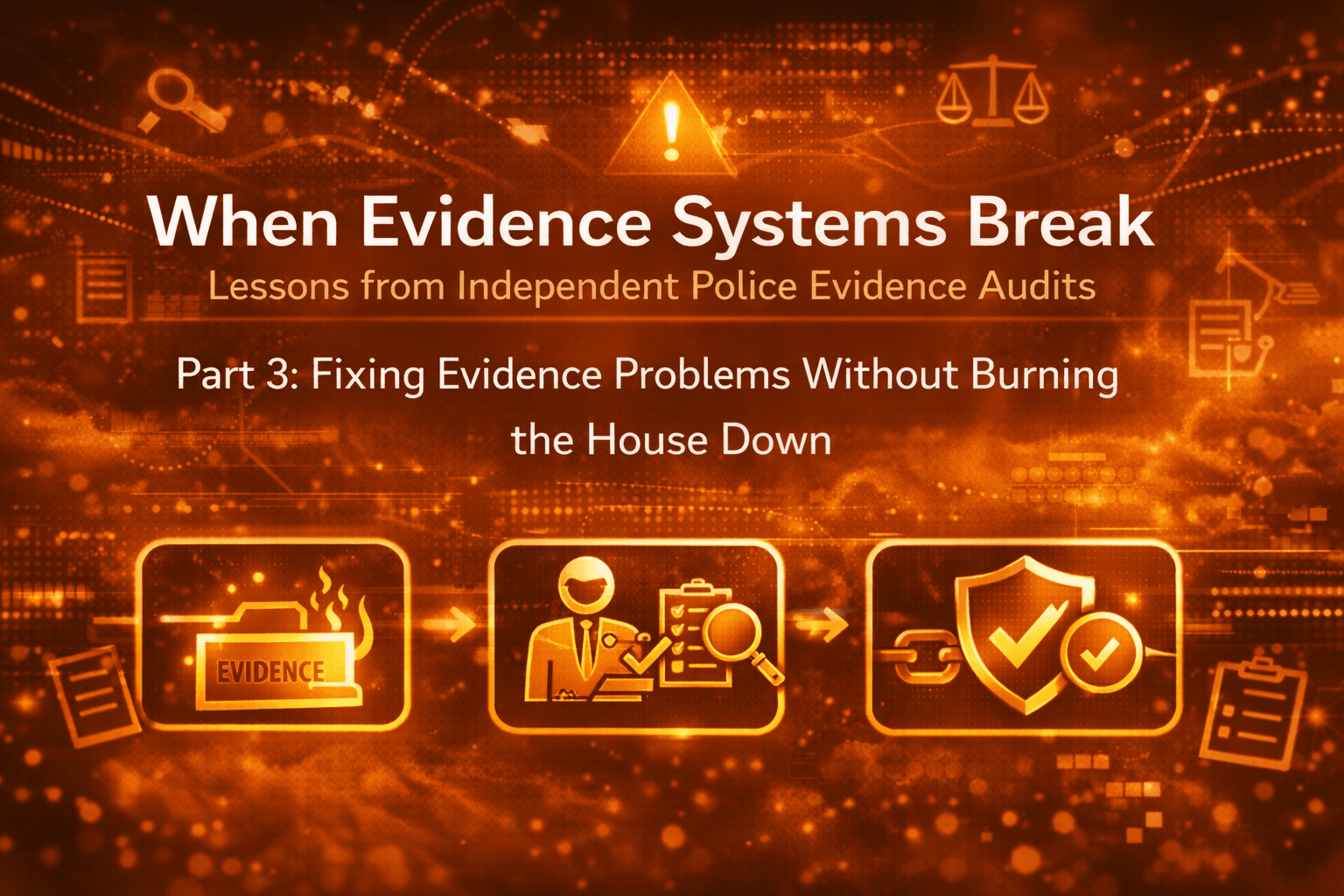
Part 3: Fixing Evidence Problems Without Burning the House Down
Contributed by Jim Brigham, LCG VP of Risk Management, Former Operations Chief, State of Vermont, Office of Safety and Security
Series context. This article continues When Evidence Systems Break: Lessons from Independent Police Evidence Audits. Part 1 established evidence failures as operational risk events driven by system drift. Part 2 examined what independent audits reveal that internal reviews often miss. Part 3 focuses on how agencies can remediate evidence issues in a controlled, leadership-safe manner that restores confidence without creating new legal, political, or operational risk. [1]
Reframing the Fear of Independent Audits
For many agencies, the greatest barrier to fixing evidence problems is not technical complexity. It is fear.
Independent audits are often perceived as risk-creating events that expose leadership to scrutiny, litigation, or discipline. In practice, unmanaged evidence systems create far greater exposure than independent review ever does. [2][3]
Courts, prosecutors, and oversight bodies do not penalize agencies for discovering weaknesses. They penalize agencies for failing to address known or knowable risks. Independent audits shift agencies from reactive defense to proactive governance by establishing an objective record of conditions, actions taken, and improvements made.
LCG perspective. Leadership risk increases with delay, not review.
Why “Fix Everything at Once” Usually Backfires
When evidence issues surface, the instinctive response is often sweeping reform. Policies are rewritten, staff are reassigned, inventories are ordered, and technology configurations are changed simultaneously.
Independent audits consistently show that this approach increases risk rather than reducing it. Rapid, unsequenced remediation can disrupt the chain of custody, confuse personnel, and undermine evidentiary continuity during active cases. [4]
Defensible remediation requires sequencing, governance, and documentation, not urgency-driven overhaul.
Principles of Defensible Evidence Remediation
Independent reviewers consistently observe that successful remediation efforts share several characteristics, regardless of agency size or resources.
Independent, Neutral Fact-Finding
Effective remediation begins with an objective assessment of current conditions. Independence matters because it allows leadership to rely on findings that are benchmarked, defensible, and free from internal bias. Neutral fact-finding also helps separate system weaknesses from individual performance concerns. [5]
No Blame or Disciplinary Framing
Evidence remediation is a governance activity, not a personnel action. Framing remediation as disciplinary discourages transparency, suppresses institutional knowledge, and incentivizes defensive behavior. Agencies that explicitly separate remediation from discipline preserve cooperation and accelerate improvement. [6]
Parallel Policy and Operational Correction
Policies should not be rewritten in isolation. Independent audits frequently identify gaps where policy is technically compliant but operationally unrealistic. Effective remediation aligns written standards with actual workflows, staffing models, and facility constraints. [7]
Legal Defensibility from the Outset
Remediation plans must be designed with litigation and disclosure in mind. Documentation should reflect good faith governance, reasoned prioritization, and adherence to recognized standards. Courts routinely distinguish between legacy conditions and leadership response once risk is identified. [8]
Chain-of-Custody Stabilization Before Cleanup
Before inventories, reorganizations, or purges occur, agencies must ensure the chain of custody is stabilized. This includes freezing nonessential movement, clarifying access controls, and ensuring contemporaneous documentation. Cleanup without stabilization risks compounding evidentiary uncertainty. [9]
Sequencing Matters More Than Speed
Independent audits consistently show that agencies regain confidence faster when they prioritize control before correction.
Early actions should focus on visibility, access management, documentation consistency, and supervisory verification. Structural improvements, facility upgrades, and technology changes should follow once baseline control is established. [10]
This sequencing allows agencies to demonstrate progress without jeopardizing ongoing cases.
Outcomes That Matter to Leadership
When remediation is properly structured, independent audits support outcomes that leadership actually values.
Restored Evidentiary Confidence
Prosecutors and courts are more concerned with present reliability than with historical imperfection. Documenting remediation reassures stakeholders that the evidence systems are trustworthy going forward. [11]
Prosecutorial Reassurance
Early engagement with prosecutorial partners, supported by independent findings, strengthens credibility and preserves charging discretion. Surprises undermine trust. Transparency restores it. [12]
Leadership Control of Timing and Narrative
Proactively conducting independent audits allows leadership to control messaging, timing, and scope. Reactive reviews conducted under external pressure do not. [13]
Documented Remediation for Courts and Councils
Clear records of assessment, prioritization, and correction demonstrate responsible governance. These records are often decisive when agencies are asked to explain evidence issues to courts, councils, or oversight bodies. [14]
Quick Checklist
- Stabilize the chain of custody before attempting system-wide cleanup.
- Separate remediation from discipline to preserve transparency.
- Document decisions, sequencing, and standards alignment from day one. [15]
Final Thought
Every department will eventually face an evidence integrity question. The only variable is whether leadership controls when and how.
Independent audits, when used early and deliberately, are not crisis tools. They are governance instruments that preserve credibility, protect leadership, and restore confidence without burning the house down.
References (endnotes)
[1] LCG Discovery, organizational governance and risk management resources, https://www.lcgdiscovery.com/
[2] ISO 31000:2018, Risk management – Guidelines, https://www.iso.org/standard/65694.html
[3] COSO, Internal Control – Integrated Framework, https://www.coso.org/internal-control
[4] U.S. Government Accountability Office, Standards for Internal Control in the Federal Government (Green Book), https://www.gao.gov/greenbook
[5] James Reason, Managing the Risks of Organizational Accidents, Routledge, https://www.routledge.com/Managing-the-Risks-of-Organizational-Accidents/Reason/p/book/9781840141054
[6] International Association of Chiefs of Police, Property & Evidence Control, https://www.theiacp.org/sites/default/files/2021-03/Evidence%20Control%20Formatted%2003.03.2021.pdf
[7] California POST Commission, Evidence and Property Management, https://post.ca.gov/Portals/0/post_docs/publications/Evidence_and_Property_Management.pdf
[8] Federal Rules of Evidence, Rule 901 Authentication, https://www.law.cornell.edu/rules/fre/rule_901
[9] National Institute of Justice, Digital Evidence Policies and Procedures Manual, https://nij.ojp.gov/library/publications/digital-evidence-policies-and-procedures-manual
[10] NIST Special Publication 800-53 Rev. 5, Security and Privacy Controls, https://csrc.nist.gov/publications/detail/sp/800-53/rev-5/final
[11] DOJ Office of Justice Programs, Forensic Examination of Digital Evidence, https://www.govinfo.gov/content/pkg/GOVPUB-J28-PURL-LPS49755/pdf/GOVPUB-J28-PURL-LPS49755.pdf
[12] The Sedona Conference, Commentary on ESI Evidence & Admissibility (Second Edition), https://www.thesedonaconference.org/publications
[13] United States v. Howard-Arias, 679 F.2d 363 (4th Cir. 1982), https://law.justia.com/cases/federal/appellate-courts/F2/679/363/12720/
[14] U.S. Department of the Interior, 446 DM 7 Evidence Management, https://www.doi.gov/sites/doi.gov/files/elips/documents/446-dm-7.pdf
[15] GAO, Green Book, principles on monitoring and corrective action, https://www.gao.gov/greenbook
This article is for general information and does not constitute legal advice.