
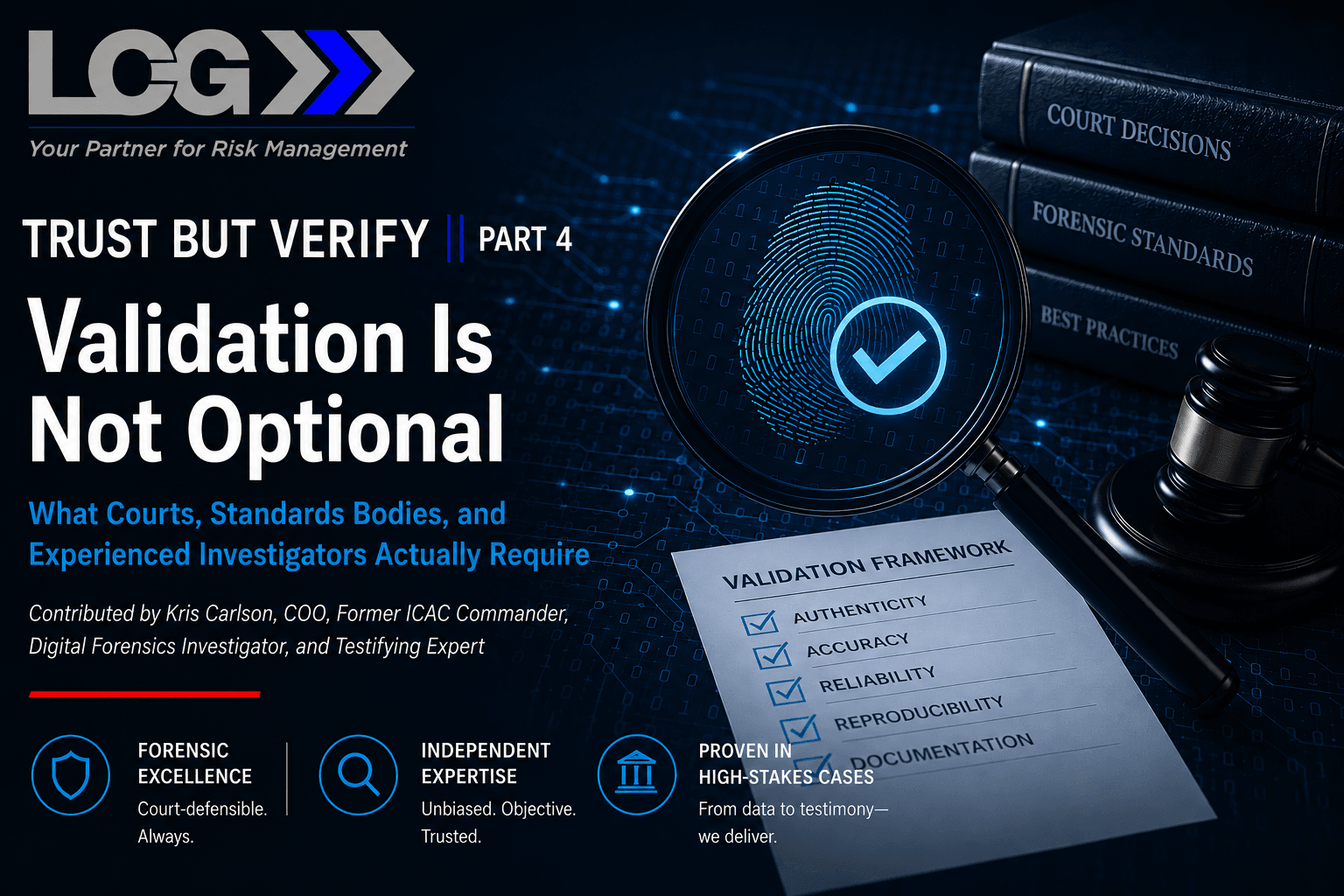
Validation Is Not Optional
What Courts, Standards Bodies, and Experienced Investigators Actually Require
Contributed by Kris Carlson, COO, Former ICAC Commander, Digital Forensics Investigator, and Testifying Expert
Series Context
In Part 1, we challenged the notion that any forensic platform should be treated as a single source of truth. Part 2 explored the danger of silent failures, where missing evidence may go unnoticed because nothing appears obviously wrong. Part 3 examined concentration risk and the operational hazards created when organizations rely too heavily on a single forensic ecosystem. Special Report 3.5 broadened the discussion by examining how consolidation within the forensic industry itself may affect innovation, competition, cost, and access to the profession.
Each article points toward the same conclusion. If forensic tools can fail, if software changes continually, and if investigative conclusions may later be scrutinized in court, then validation is not a luxury or a technical formality. It is the foundation upon which every defensible forensic opinion is built.
The Question Every Examiner Eventually Hears
Every experienced digital forensic examiner eventually reaches a familiar moment. The acquisition has completed. The evidence has been processed. The report has been generated. Thousands of artifacts have been organized into timelines, conversations, photographs, locations, application records, browser history, cloud data, and user activity. The software has transformed raw information into something investigators, attorneys, executives, and juries can understand. Everyone in the room appears satisfied. Then someone asks a simple question: How do you KNOW the software got it right?
That is a question any good attorney should be asking of a forensic examiner or expert witness! That question is not an attack on the examiner. It is not a suggestion that the software is defective. It is a request to explain the difference between trust and proof.
Modern forensic platforms recover deleted files, reconstruct conversations, analyze cloud accounts, normalize timestamps, parse application databases, identify operating system artifacts, and generate reports that would have required weeks of manual analysis only a generation ago. Law enforcement agencies, corporate investigators, litigation teams, and incident response professionals depend on these tools every day, and they should, as the profession could not function at its current scale without them.
But dependence should never become complacency. The question is not whether forensic software deserves trust. The real question is whether trust, by itself, is enough. Courts, standards bodies, and experienced investigators have consistently answered that question. Trust is where forensic work begins. Validation is how it earns credibility.
| LCG Perspective. Validation is not about distrust. It is about accountability. The more important a tool becomes to an investigation, the more important it is to understand what it does well, where its limitations exist, and when its results require independent confirmation. |
Confidence Is Not Defensibility
One of the greatest strengths of modern forensic software is also one of its greatest risks: the confidence it can create. Sophisticated interfaces organize evidence into logical categories; reports present findings clearly; timelines reconstruct months of activity in seconds; messages appear as conversations rather than database records; photographs may be displayed alongside location information; and cloud artifacts may appear integrated with local evidence.
That presentation is enormously useful, but it also creates a subtle risk. When information is organized cleanly and presented with apparent completeness, users can begin to assume that it has also been interpreted correctly. The danger is not that investigators become careless, but that confidence gradually replaces curiosity. Examiners must continue to ask the question that sits at the center of validation: what might I NOT be seeing?
Validation is not an attempt to prove that forensic software is unreliable. It is a practical inquiry into whether a particular tool can be relied upon to perform a particular function, under particular conditions, with a particular evidence source, in support of a particular conclusion.
That question is very different from asking whether the vendor is reputable, whether the platform is widely used, or whether prior cases were completed successfully. A laboratory may have complete confidence in its primary forensic platform while still recognizing that certain mobile applications are only partially supported. An examiner may trust a cloud collection process while still validating timestamp interpretation after a major operating system update. Those positions are not contradictory. They reflect professional maturity. Confidence is valuable, but defensibility requires more. It requires evidence that the methodology, not merely the software output, can withstand scrutiny.
Popularity Is Not Validation
One of the most common statements heard in digital forensics sounds perfectly reasonable: Thousands of investigators use the software. Sometimes the statement is framed another way: it is the industry standard, or nearly every major laboratory uses this platform. Those statements may be true, but they are not validation.
Popularity has never been a scientific standard, even though some tools are ubiquitous in the forensics industry across both governmental and private organizations. Commercial success does not prove that a specific function performs reliably under the conditions present in a particular examination.
The forensic profession can fall into a subtle trap when a platform becomes widely adopted and deeply embedded in daily practice. Training programs are built around it; organizations standardize their workflows around it; certifications develop around it; and experienced examiners become highly proficient in its use. Over time, the software becomes familiar enough that its output may receive less scrutiny than it should. The risk is that the platform begins to function not merely as a tool used by the examiner, but as something whose conclusions are accepted by default.
This shift usually happens gradually rather than by design. As a platform becomes more familiar, reports generated from that platform may receive less scrutiny than reports produced by a less familiar tool. Investigators, managers, attorneys, and even opposing experts may become comfortable with the format, terminology, and appearance of the output. But familiarity should not be mistaken for validation, and comfort should not be treated as evidence of accuracy.
Widespread adoption can actually make independent validation more important, not less. If a widely used platform contains a parsing issue, a reporting limitation, or an unsupported artifact, the consequences may extend to many organizations that unknowingly rely on the same assumption. Validation helps interrupt that cycle by requiring examiners to ask the difficult questions before someone else raises them.
What Courts Actually Expect
Every examiner who has testified eventually learns that the courtroom is not primarily interested in software. It is interested in methodology.
Within the forensic community, conversations often revolve around tools. Which platform supports the newest operating system? Which parser recovered the most artifacts? Which suite processes evidence the fastest? Those questions matter during an investigation. They matter much less once the investigation becomes evidence.
When a forensic opinion is challenged, the focus shifts to the examiner. What did you do? Why did you do it? How do you know your conclusions are reliable? Could another qualified examiner reproduce the same results? How were known limitations considered? What documentation supports the methodology?
Courts do not certify commercial forensic software. They do not endorse vendors, approve platforms, or decide that one software package is superior to another. They evaluate whether the expert’s methodology is reliable and whether that methodology was applied reliably to the facts of the case.
Federal Rule of Evidence 702 reflects this principle. It requires that expert testimony be based on sufficient facts or data, that it result from reliable principles and methods, and that those principles and methods be reliably applied. Daubert v. Merrell Dow Pharmaceuticals similarly focuses on the characteristics of reliable scientific methodology, including testability, peer review, error rates, standards, and general acceptance.
General acceptance matters, but it is not the entire inquiry. Popularity does not replace testing. Market share does not replace repeatability. Vendor reputation does not replace methodological discipline. Most importantly, scientific reliability cannot be outsourced.
The examiner who can explain why a finding is reliable will always be in a stronger position than the examiner who can only explain which software produced it. Validation shifts the conversation away from trusting a product and toward demonstrating a defensible investigative process.
| LCG Perspective. The strongest expert witnesses rarely spend much time defending the software they used. They explain the methodology they followed, the controls they implemented, the limitations they considered, and the validation they performed. Confidence grounded in documented methodology is far more persuasive than confidence grounded in vendor reputation. |
Documentation Is the Difference Between Memory and Evidence
Years may pass between a forensic examination and testimony. During that time, personnel may change, software may evolve, organizations may reorganize, and memories may fade. Documentation preserves what memory cannot reliably maintain.
One of the least appreciated benefits of validation is that it creates an enduring record of professional diligence. A properly documented validation effort demonstrates far more than software performance. It shows that known datasets were examined, expected outcomes were established, results were compared, unexpected behavior was investigated, limitations were identified, and corrective actions were considered.
That documentation becomes part of the methodology itself. Without it, the examiner may be left explaining, from memory, why a tool was trusted, which version was used, what was tested, and whether known limitations were known or considered at the time. With it, the methodology can be explained through a record created during the work.
Documentation also protects the organization by preserving institutional knowledge when examiners leave, software versions change, and questions arise years after the original work was completed. Courts, regulators, clients, and opposing experts are more likely to trust a process documented contemporaneously than one reconstructed only after a challenge appears.
Building a Culture of Validation
The strongest forensic organizations rarely distinguish themselves only by the software they purchase. More often, they distinguish themselves by the questions they ask. Can we reproduce these results? Has anyone independently verified this conclusion? What assumptions are we making? What changed since we last validated this process?
Those questions become habits. Those habits become culture. Culture determines whether validation is viewed as an administrative requirement or as an essential component of professional practice.
Organizations that view validation as a compliance exercise tend to perform it only when policy requires it. Organizations that view validation as part of investigative integrity perform it because they recognize that every examination carries uncertainty. Their objective is not merely to satisfy an accreditation requirement. Their objective is to reduce uncertainty before it influences an investigative conclusion.
That culture begins with leadership. Examiners must know that identifying a discrepancy is considered a contribution to quality, not a problem. A laboratory that rewards only speed may unintentionally discourage questions that delay completion. A laboratory that rewards curiosity is more likely to detect emerging issues before they affect casework.
Training should reinforce the same principle. Examiners must learn how to use forensic tools, but they must also learn when not to accept tool output at face value. Unsupported application versions, unexpected timestamps, changes to database structures, incomplete cloud collections, or results inconsistent with other evidence should prompt additional scrutiny. Validation is not only a laboratory process. It is a professional mindset.
Validation Is Risk Management
Validation is often described as a technical process, but at its core it is a risk management process. Like every other high-consequence profession, digital forensics operates in an environment where uncertainty cannot be eliminated entirely. Pilots cannot remove every possibility of mechanical failure, surgeons cannot prevent every complication, financial institutions cannot stop every fraudulent transaction, and cybersecurity teams cannot block every attack. Mature organizations do not pretend that uncertainty does not exist; they identify it, measure it, monitor it, and implement controls designed to reduce its impact.
Digital forensics should be viewed through the same lens. Validation is one of the controls that helps reduce the risk that unknown tool limitations, unsupported artifacts, parser issues, or workflow assumptions will influence investigative conclusions before those weaknesses are understood. Its purpose is not to prove that software is flawless. Its purpose is to help the organization understand when, how, and under what conditions a tool can be relied upon.
The better question is not simply whether a tool has been validated. The better question is what investigative risks remain after validation. That shift in focus matters because it moves the discussion from software approval to risk awareness. It requires the examiner and the organization to consider what is known, what remains uncertain, and what additional verification may be necessary before a conclusion is presented as reliable.
Every investigation begins with some degree of uncertainty. Devices may be damaged, evidence may be incomplete, applications may no longer exist, cloud data may have changed, users may have deleted records, and operating systems or applications may have evolved since the last validation effort. Validation does not eliminate those uncertainties, but it helps the organization understand and manage them.
Unknown uncertainty creates risk. Known uncertainty supports informed decision-making. A laboratory that understands a parser limitation is in a stronger position than one that assumes the parser is complete. An examiner who documents unsupported artifacts demonstrates professional judgment. An examiner who never considered the possibility may present incomplete conclusions with unwarranted confidence.
Peer Review Strengthens the Methodology
Peer review should be part of any mature validation culture. Digital forensic examinations often involve large volumes of data, complex artifacts, evolving applications, and interpretive decisions that may affect investigative findings, productions, opinions, or testimony. Even experienced examiners can develop expectations based on the facts of the case, the referral question, prior findings, or the way a tool presents the evidence.
A second examiner brings a different perspective to the same material. That second examiner should approach peer review from an opposing perspective, asking, “Where would I attack these findings?” This methodology? This analysis?” The peer reviewer may ask different questions, test different assumptions, notice inconsistencies, identify alternative explanations, or recognize when a finding requires additional validation. Peer review is critically important when an artifact is central to the conclusion, when the evidence source is unusual, when tool output is unexpected, or when the matter carries significant legal, regulatory, financial, or reputational consequences.
Peer review is not a sign that the first examiner failed. It is a recognition that forensic work is strengthened when important conclusions are tested before they are relied upon. The purpose is not to second-guess the examiner, but to protect the methodology, the organization, the client, and the evidence itself.
Organizations that value peer review demonstrate that they place scientific rigor above individual certainty. A conclusion that has been reviewed, questioned, and confirmed is more defensible than one that rests solely on a single examiner’s interpretation or a single tool’s output.
From Principles to Practice
One challenge with discussing validation is that the concept can seem overwhelming. Organizations sometimes assume they must build elaborate quality systems, purchase additional software, or dedicate significant resources before meaningful validation can begin. In reality, strong validation programs often begin with a disciplined process.
Validation is not defined by complexity. It is defined by consistency. Organizations that consistently ask the right questions will generally outperform organizations that own more sophisticated tools but fail to challenge their assumptions.
The objective is not to eliminate every possible uncertainty. No forensic laboratory can accomplish that. The objective is to ensure that uncertainty is understood, documented, and appropriately managed before investigative conclusions are presented as fact.
A Practical Validation Framework
Identify What Is Actually Being Validated. Modern forensic suites contain thousands of individual capabilities, so validation should focus on the specific functions that support investigative conclusions. Examples include mobile device acquisition, physical image verification, SQLite parsing, browser artifact recovery, cloud collection, timeline generation, keyword searching, and export functionality.
Build Known Test Data. Validation only has value when the expected outcome is already known. Laboratories should use datasets containing known messages, timestamps, photographs, application activity, deleted files, and cloud synchronization events. Validation is not the discovery of evidence. It is the confirmation that a process correctly identifies evidence already known to exist.
Use More Than One Method When Risk Requires It. Significant findings should, when practical, be tested through an alternative methodology. That may include a second commercial platform, open-source tools, manual SQLite review, hex-level analysis, native operating system artifacts, or cloud provider records. Agreement between independent methodologies provides stronger confidence than repeated analysis using the same process.
Validate After Change. Software updates, parser revisions, operating system changes, application updates, cloud API modifications, and new artificial intelligence features should trigger questions. Organizations that integrate validation into change management experience fewer surprises than organizations that validate only during initial deployment.
Document the Process. Documentation should answer what was tested, why it was tested, how it was tested, what was expected, and what actually occurred. The purpose is not paperwork. It is organizational memory and evidence of methodological discipline.
Final Thought
Throughout this series, one message has appeared in different forms: no forensic platform should be treated as a single source of truth. Silent failures can be more dangerous than obvious errors. Concentration creates vulnerability. Healthy forensic practice depends on diversity, competition, independent thinking, sound methodology, and professional judgment.
These ideas are not arguments against forensic software. They are arguments for using powerful tools with the level of care their influence requires. Modern forensic platforms have transformed the profession, and they will continue to do so. But responsibility for the conclusion does not lie with the software. It belongs to the examiner and to the organization relying on that examiner’s work.
Digital forensics is not fundamentally about producing artifacts, reports, or timelines. It is about building confidence in conclusions. That confidence comes from understanding the evidence, knowing the limits of the tools, documenting the methodology, questioning assumptions, and recognizing when important findings require additional scrutiny.
Years from now, today’s forensic platforms will be replaced by more capable technologies. Operating systems will change, applications will disappear, artificial intelligence will become more common, and the names of today’s software vendors may be different. The principles of good forensic practice will not change as quickly. Examiners will still need to understand what was collected, what was processed, what was missed, what was assumed, and how the conclusion was reached.
Long after individual tools have changed, investigators, attorneys, regulators, courts, and clients will continue to ask the same question: How do you actually know? The strongest answer will never begin with the name of a software product. It will begin with the evidence, continue with the methodology, and end with a conclusion that can be explained, tested, documented, and defended.