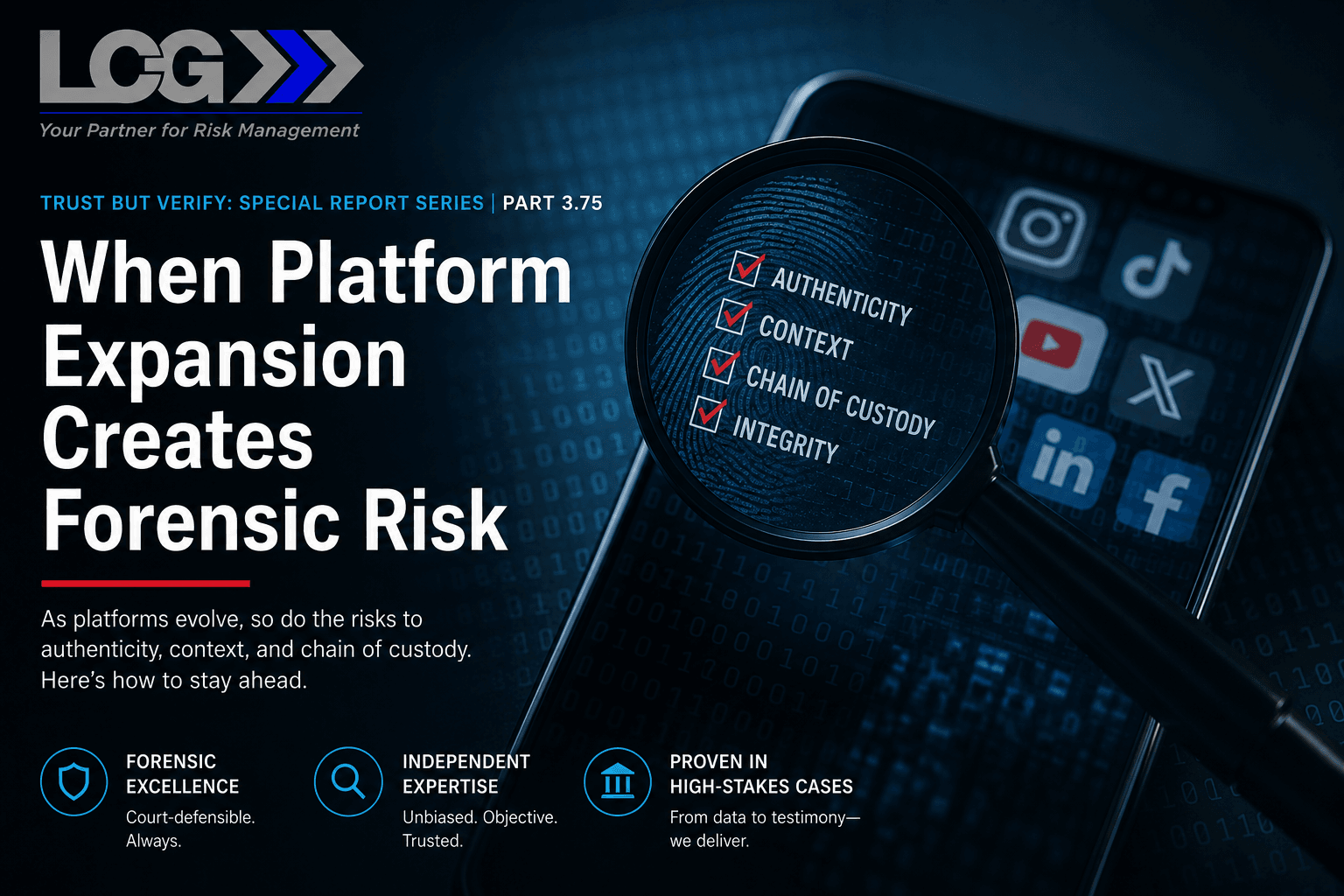
When Platform Expansion Creates Forensic Risk
How platform expansion, support strain, and vendor sprawl create risk for small forensic operations
Contributed by Kris Carlson, COO, Former ICAC Commander, Digital Forensics Investigator, and Testifying Expert
Series Context. In Part 3, we examined concentration risk inside forensic investigations. In Special Report 3.5, we examined how consolidation, pricing, and vendor dependence can affect the broader digital forensics industry. Before moving on to Part 4, there is another related issue worth addressing: what happens when forensic software vendors grow so large, and attempt to support so many evidence types, workflows, and markets, that their platforms become both essential and increasingly difficult to rely upon?
The Promise and Problem of the “Everything Platform”
Digital forensic software has changed dramatically over the past decade. Many platforms that once focused on a narrower set of functions now promise broad support across mobile devices, computers, cloud accounts, collaboration platforms, messaging applications, social media, email systems, enterprise data, malware, incident response, analytics, review workflows, reporting, and testimony support.
That growth is understandable. Modern investigations are no longer limited to a single hard drive, a single mobile device, or a single application. Evidence may exist across phones, laptops, cloud services, messaging platforms, browser artifacts, SaaS tools, third-party applications, and corporate systems. Examiners need tools that can help them move quickly across that environment.
Larger vendors have helped meet that need. They have built powerful platforms, expanded artifact support, improved automation, and created workflows that allow investigators to process larger volumes of data more efficiently than ever before…But there is a tradeoff. As platforms expand, the risk of overextension grows. A vendor that tries to support every device, every application, every cloud source, every operating system, every evidence type, and every investigative workflow may eventually confront the practical limits of scale. The result can be a forensic version of the familiar warning: “jack of all trades, master of none.”
In digital forensics, that is not just a business concern. It can become an evidentiary concern.
LCG Perspective. Broad forensic platforms can create tremendous efficiency, but capability should not be confused with mastery. The fact that a tool supports a data source does not mean it fully understands it, parses it correctly, explains it clearly, or resolves every issue defensibly.
Feature Expansion Can Outrun Quality Control
One of the most difficult challenges for large forensic vendors is maintaining quality while continuously expanding capability. Every new data source, artifact category, cloud connector, reporting feature, analytics module, or automation layer adds complexity. That complexity must be tested.
Testing a forensic tool is not the same as testing a general business application. A forensic tool may influence legal conclusions, investigative decisions, regulatory findings, employment actions, criminal prosecutions, civil litigation strategy, expert opinions, and courtroom testimony. When a new feature is released, the question is not simply whether the interface works. The question is whether the tool accurately identifies, preserves, parses, normalizes, categorizes, and reports data in a way that can be defended.
The larger the platform becomes, the more difficult it is to test every supported condition and cross platform impacts of updates. A mobile artifact may behave differently depending on device model, operating system version, application version, user settings, encryption state, backup method, cloud synchronization behavior, and acquisition type. A cloud collection may vary depending on user permissions, API limitations, authentication method, tenant settings, retention rules, or provider changes. A parser may work correctly for one version of an application while failing silently on another. No vendor can perfectly test every permutation.
This does not mean vendors are careless. It means the environment is too complex for any single company to fully control. When vendors continue expanding into new areas, the risk is that quality assurance becomes increasingly dependent on customer discovery. In other words, the field becomes part of the testing process. That should concern forensic practitioners. If defects are discovered only after examiners encounter them in active matters, then real cases become the proving ground for platform maturity.
LCG Perspective. Innovation is important, but forensic reliability depends on more than feature releases. The more a platform expands, the more important it becomes for practitioners to validate critical artifacts, understand tool limitations, and avoid assuming that new capability equals proven reliability.
The Roadmap May No Longer Reflect the Examiner’s Needs
As forensic vendors grow, their priorities often shift. Early-stage tools are frequently shaped by practitioner feedback, examiner pain points, and specific investigative problems. Larger platforms, however, may become increasingly influenced by enterprise sales, investor expectations, government contracts, market positioning, bundled offerings, and competitive feature comparison.
Features that matter deeply to working examiners may receive less attention than features that are easier to market. A small parsing defect affecting a specific artifact may be less visible than a new dashboard, a new analytics layer, or a broader enterprise integration. Improvements to logging, validation transparency, export consistency, or artifact-level documentation may be less attractive from a sales perspective, even though they may be far more important to forensic defensibility.
This is especially challenging for small forensic operations. Small firms often need practical, reliable, case-focused functionality. They need tools that correctly acquire data, accurately parse artifacts, clearly document errors, export defensibly, and enable examiners to explain what happened. They may not need large-scale enterprise management, automated collaboration, advanced review workflows, or broad analytics modules. Over time, the examiner’s needs and the vendor’s commercial priorities can drift apart. The tool may continue to become larger and more expensive, but not necessarily more useful for the work a smaller forensic provider actually performs.
LCG Perspective. A forensic platform should not be judged only by the number of features it advertises. It should be judged by whether its capabilities solve real investigative problems, whether its limitations are transparent, and whether its outputs can be independently explained and defended.
Documentation and Transparency Do Not Always Scale
Forensic examiners need to understand what their tools are doing. That includes acquisition methods, parser logic, artifact definitions, timestamp handling, unsupported conditions, known limitations, error states, and changes between versions. As platforms grow, that transparency can become harder to maintain.
A release may include hundreds of changes across multiple evidence types. Some may be described clearly. Others may be summarized broadly. Some defects may be fixed without enough detail for examiners to understand whether prior matters were affected. Some artifact changes may alter how data is categorized, displayed, or exported. Some parsing behavior may change without an obvious explanation of the underlying logic. That creates a problem for forensic defensibility.
If an examiner cannot determine how a tool interpreted an artifact, what changed between versions, whether a prior parser contained a relevant defect, or whether a known limitation affected a case, the examiner’s ability to explain the work is reduced. That matters across every forum where forensic findings may be scrutinized, including litigation, expert testimony, regulated investigations, and internal corporate matters.
For small forensic operations, limited transparency can be especially burdensome. Larger organizations may have dedicated validation teams, vendor relationships, internal testing environments, and multiple examiners who can compare results. Smaller firms may have to make those determinations with fewer resources and under tighter deadlines.
The Hidden Risk of Constant Tool Updates
Frequent software updates are necessary in digital forensics. Vendors must respond to new devices, new operating systems, application changes, security updates, cloud provider modifications, and newly discovered defects. Without regular updates, forensic tools would quickly lose relevance. But frequent updates also create operational risk.
A new version may fix one issue while introducing another. A parser may improve for one application version but behave differently with older data. An export format may change. A report field may be renamed. A timeline may categorize artifacts differently. A previously supported workflow may now require a different process. A known issue may be resolved, but only if the examiner knows to reprocess the evidence.
Forensic organizations must then decide when to update, when to wait, when to reprocess, and when to preserve prior results. These decisions are not always simple. Updating too quickly may introduce untested behavior. Waiting too long may leave known defects unresolved. Reprocessing may change reported results, requiring explanation to clients, counsel, courts, or investigators.
For small forensic operations, version management can be difficult. Maintaining test images, tracking tool behavior across versions, documenting changes, and validating critical workflows requires time that may not be billable and resources that may already be stretched thin.
The Small Firm Squeeze
Small forensic operations occupy an important place in the digital forensics ecosystem. They often provide specialized expertise, practical experience, flexible service models, direct examiner involvement, and independent perspectives. Many are built by former law enforcement examiners, corporate investigators, incident responders, and expert witnesses who bring years of real-world experience to private practice. But the current vendor environment can place these firms under significant pressure.
They must maintain expensive tools, renew licenses, attend training, preserve certifications, invest in hardware, secure data, manage storage, carry insurance, maintain compliance, and keep up with rapidly changing technology. They must do this while competing against larger firms that can spread those costs across more matters and larger teams.
When vendors grow larger and pricing models become less flexible, small firms may have fewer options. They may be forced to choose between maintaining critical tools, reducing validation options, increasing client rates, narrowing service offerings, or declining certain types of work. None of those outcomes strengthens the industry.
The concern is not merely that small firms may struggle. The concern is that the forensic field may lose diversity, competition, specialized expertise, and independent voices. That loss would affect clients, courts, investigators, law firms, corporations, and public agencies that depend on reliable forensic work.
LCG Perspective. A healthy forensic industry needs more than dominant platforms. It needs viable small firms, specialized practitioners, independent validation, and a marketplace where expertise can compete with scale.
Building Resilience Against Vendor Overextension
Forensic organizations cannot control vendor consolidation, pricing strategies, or product roadmaps. But they can control how they manage dependency.
A mature forensic program should consider:
- Maintaining secondary tools for critical evidence types.
- Validating important artifacts through independent methods when possible.
- Documenting tool versions, known issues, processing errors, and support communications.
- Preserving test data and known result sets for recurring validation.
- Avoiding unnecessary dependence on proprietary reporting formats.
- Reviewing release notes and update behavior before adopting new versions in active matters.
- Developing escalation procedures for unresolved vendor support issues.
- Training examiners to understand underlying data structures rather than relying only on tool displays.
- Separating marketing claims from validated capability.
- Budgeting for tool diversity as a reliability requirement, not merely a business preference.
These practices do not eliminate vendor risk. They reduce the chance that vendor risk becomes investigative risk.
Final Thought
Digital forensics depends on software, but it cannot depend on software alone. It depends on examiners who understand the limits of their tools, organizations that invest in validation, vendors that provide transparency, and a marketplace that remains diverse enough to encourage accountability.
As forensic vendors grow larger and attempt to support more of the investigative lifecycle, the profession should remain clear eyed about the tradeoffs. Bigger platforms may deliver efficiency, but they can also create complexity. Broader tools may offer convenience, but they can also encourage dependency. Consolidated vendors may provide powerful solutions, but they can also weaken customer leverage and strain support capacity.
For small forensic operations, these pressures are not theoretical. They affect daily casework, pricing, staffing, validation, client communication, and the ability to compete. More importantly, they affect the independence and resilience of the forensic process itself.
The lesson is the same one this series has returned to repeatedly:
Trust the tools when they perform well. Respect the vendors that help move the field forward. But verify the results, preserve alternatives, and never confuse market dominance with forensic certainty.
In digital forensics, dependence creates risk. Diversity creates resilience. And no platform should become so large that the profession forgets how to question it.