

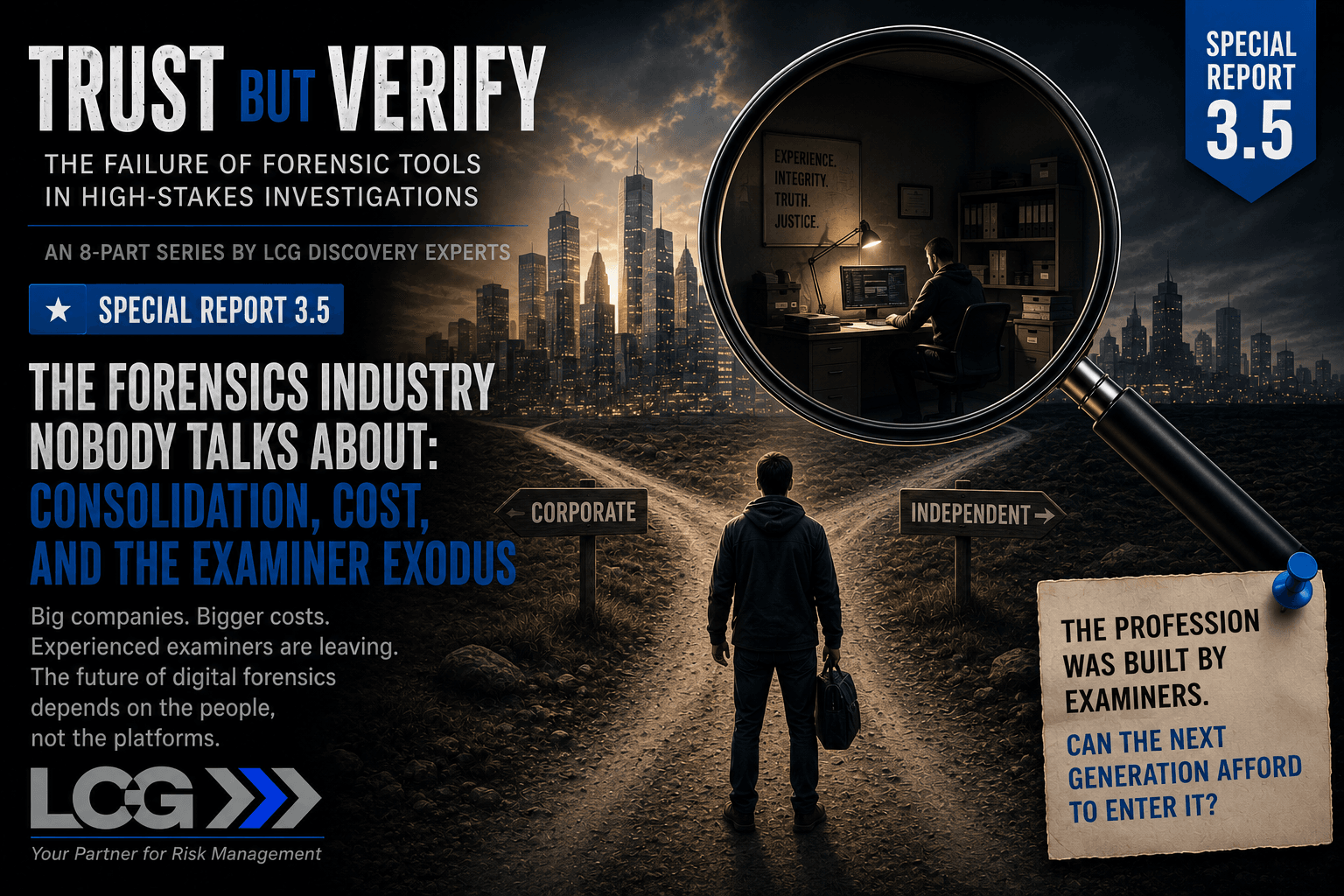
The Forensics Industry Nobody Talks About
How consolidation, pricing, and vendor dependency threaten the future of digital forensics
Contributed by Kris Carlson, COO, Former ICAC Commander, Digital Forensics Investigator, and Testifying Expert
Series Context. In Part 3, we examined concentration risk inside forensic investigations. But concentration risk does not begin with the examiner’s workflow. It begins much earlier, within the forensic industry itself. Before discussing validation requirements in Part 4, it is worth examining a difficult question: What happens when fewer companies control more of the tools that investigators depend upon? [1]
The Quiet Consolidation of Digital Forensics
Most discussions of forensic reliability focus on technology; however, few address economics. Yet after many discussions with former colleagues who are attempting to break into the civilian forensics market, economics may become one of the most important forces shaping the future of digital forensics.
Over the past decade, the forensic software market has changed significantly. Acquisitions, mergers, private equity investment, and the growing dominance of a relatively small number of vendors have reshaped the tools, pricing models, and options available to forensic laboratories, consulting firms, corporations, and government agencies.
That shift is not necessarily negative. In many respects, consolidation has produced stronger platforms, greater development resources, broader artifact support, and more integrated workflows. Larger vendors may be better positioned to respond to changing operating systems, new application structures, cloud platforms, and emerging evidence sources.
BUT, consolidation also creates risk.
Risk managers understand this principle well. When any market becomes dependent on a small number of critical providers, resilience can decline. Pricing power becomes more concentrated, and customer leverage can weaken. Innovation may become more closely tied to the priorities of dominant vendors rather than to the needs of examiners and practitioners. Moreover, new entrants into the civilian industry may face higher barriers to entry and competition, and smaller organizations may find it harder to maintain access to the tools they need.
As fewer vendors control more of the essential forensic technology stack, the cost, availability, and direction of those tools can directly affect how investigations are conducted, how evidence is reviewed, and who can realistically participate in the field.
LCG Perspective. Concentration risk does not exist only within an investigation. It can also exist in the marketplace that supplies the tools used to conduct the investigation.
Forgetting The Practitioners Who Paved the Way
The modern digital forensics industry developed in significant part from the urgent need to investigate child sexual abuse material cases. By the mid to late 1990s, when our CEO and I began our forensic careers, many early tools, workflows, and laboratory practices were being shaped by the practical demands of those investigations. Examiners needed defensible methods to identify contraband images, preserve digital evidence, recover deleted files, establish possession or distribution, and present findings in criminal proceedings.
That history matters. It helps explain why many forensic platforms were originally built around law enforcement needs, including large-scale media review, file identification, hash matching, categorization, recovery of deleted files, and evidentiary reporting. Those capabilities were developed by practitioners working under difficult conditions, often while exposed to deeply disturbing material and while learning technical disciplines that were still emerging.
Over time, the field expanded well beyond its original criminal investigative roots. The same core skills that developed through law enforcement and public safety work now support mobile device forensics, computer forensics, cloud investigations, malware analysis, incident response, corporate investigations, civil litigation, regulatory matters, eDiscovery, and expert testimony.
The industry’s growth is important, but so is remembering the professionals who helped build it. Many of the practitioners who paved the way did so through years of difficult casework, technical experimentation, courtroom scrutiny, and exposure to some of the most serious evidence encountered in digital investigations.
Eventually, some leave government service seeking new opportunities, escape from the rigors of difficult criminal investigations, better compensation, or greater professional independence. Historically, many opened consulting firms, joined boutique forensic practices, or launched specialized investigative businesses. Today, however, that path is becoming increasingly difficult.
Large vendor licensing models frequently include recurring year-over-year cost increases. Those increases are imposed at will, without regard to whether a company’s case volume, staffing, or actual use of the platform has changed, where the vendor’s pricing model remains focused on revenue growth, product bundling, and market position. The burden of absorbing those increases falls on the firms, agencies, and practitioners who depend on the tools to perform their work. What may begin as a manageable annual license can become a growing fixed expense that must be absorbed before a single case is opened. For smaller forensic providers, underfunded public agencies, and specialized practices, annual increases can force difficult decisions about which tools to maintain, which capabilities to reduce, and which types of matters remain economically feasible.
The result is an uncomfortable paradox: The people who helped build the profession may no longer be able to afford to participate in it at the same level, or at all.
When Small Firms Cannot Compete
Competition is healthy for digital forensics. It drives innovation, improves service quality, creates alternatives when tools fail, and helps ensure that no single methodology or vendor perspective dominates the field. Yet many small forensic organizations are facing increasing difficulty competing with larger firms that can spread software, infrastructure, and compliance costs across a broader client base.
The challenge is not limited to the price of forensic software. It is the cumulative effect of licensing fees, annual renewals, certification requirements, hardware investments, training expenses, cloud processing costs, data storage costs, cybersecurity requirements, and insurance obligations. Each expense may be reasonable when viewed in isolation, but collectively they create a substantial barrier to entry and an ongoing burden for smaller providers.
Vendor consolidation intensifies this problem through bundled software packages and broader licensing structures. These bundles may offer value for some organizations, particularly those handling large volumes of varied work. But they can also require laboratories, agencies, and consulting firms to pay for capabilities they may not need in many standard forensic investigations.
A matter involving routine computer analysis or mobile device preservation may not require advanced cloud collection, analytics, automation, collaboration, or enterprise-scale features. Yet the pricing model may require those modules to be part of the overall cost of access. Over time, this can increase the cost of forensic work, reduce flexibility, and make it harder for smaller organizations to tailor their toolsets to the actual needs of their cases.
The broader risk is that the industry gradually loses diversity. As costs rise, there may be fewer independent practitioners, fewer specialized firms, fewer alternative approaches, and fewer voices willing or able to challenge conventional assumptions. That should concern everyone who depends on reliable forensic work. From a risk management perspective, a less diverse forensic marketplace is not merely a business issue. It is a resilience issue. The field benefits when different organizations, tools, methods, and perspectives remain viable.
Some of the most important advances in digital forensics have not originated from dominant market players. They have often emerged from independent researchers, open-source communities, boutique forensic firms, academic institutions, and practitioners solving real-world problems. If economic pressures reduce participation by smaller organizations, the industry risks losing a critical source of experimentation and creativity.
That loss may not be immediately visible; however, over time, it affects everyone.
Why This Matters for Investigative Integrity
This discussion is not fundamentally about pricing. It is about resilience.
A healthy forensic ecosystem requires more than capable tools. It requires multiple vendors, independent validation capabilities, diverse methodologies, accessible training pathways, sustainable business models, and opportunities for new entrants. Without those elements, concentration risk grows. As concentration risk grows, so do the consequences when a tool, vendor, pricing model, or support structure fails.
The forensic community has spent years teaching investigators not to rely on a single source of evidence. The same principle should apply to the industry itself. If independent sources strengthen forensic conclusions, the forensic marketplace is strengthened by independent providers, diverse tools, and viable alternatives.
Final Thought
Digital forensics depends on more than software. It depends on people, expertise, competition, and a professional ecosystem capable of sustaining innovation, attracting talent, and challenging assumptions.
The future of forensic reliability will not be determined solely by what happens inside forensic tools. It will also be shaped by the marketplace that funds them, the professionals who use them, the organizations that validate them, and the competitive environment that pushes them to improve.
If the industry becomes too concentrated, too costly, or too dependent on a small number of providers, the consequences will extend beyond business operations. They will affect access, independence, innovation, and ultimately the reliability of forensic work itself.
An industry that becomes too concentrated may eventually discover the same lesson investigators learn every day:
Dependence creates risk.
Diversity creates resilience.